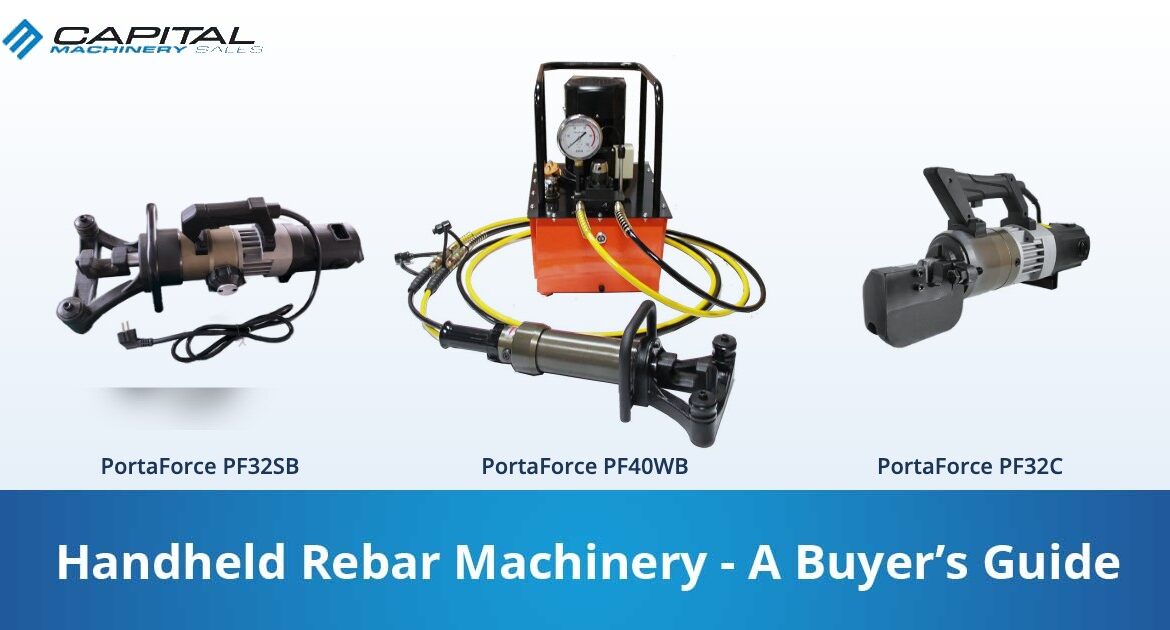
Handheld Rebar Machinery – A Buyer’s Guide
The variety of portable rebar machines that are available can make it a challenging task if you don’t know what to look out for. It is important to consider a few different factors when purchasing a portable/handheld rebar cutter/bender, such as the volume of work, rebar size, power requirements, and so on. We highlight these points, and more, below.
Portable rebar machines are carried to the job to cut, bend and straighten reo on site. The range below covers bar from 4mm to 40mm, in manual, 240V electro-hydraulic, cordless battery and pneumatic models. Capital Machinery Sales supplies, services and supports them across Australia.
Which portable rebar machine for which bar size
Pick a machine rated above the biggest bar you work with on site. Capacities below are as stated on each product page. Makers rate capacity at different steel strengths, so check the rating on the page or ask us for your bar grade.
| Model | Type | Power | Capacity |
|---|---|---|---|
| Reflex Bramley | Manual bender | Manual | Up to 16mm mild steel |
| Diamond HB16W | Bender | Electric | Up to 16mm, bends to 135° |
| PortaForce PF22B | Bender | 240V electro-hydraulic, 10 amp | 10 to 22mm |
| PortaForce PF25B | Bender | 240V electro-hydraulic, 10 amp | 20 to 25mm (12 to 25mm with optional roller) |
| PortaForce PF32B | Bender | 240V electro-hydraulic, 15 amp | 25 to 32mm |
| PortaForce PF32SB | Bender and straightener | 240V electro-hydraulic, 15 amp | 22 to 32mm (12 to 32mm with optional double hook) |
| Diamond DBR32-HD | Bender and straightener | Electric, hydraulic cylinder | Up to 32mm (rated to 620N/mm²) |
| PortaForce PF32WB | Bender and straightener | Separate hydraulic pump and hoses | 4 to 32mm, bends 0 to 130° |
| PortaForce PF40WB | Bender and straightener | Separate hydraulic pump and hoses | 4 to 40mm, bends 0 to 130° |
| Reflex CBX-22, CBX-25, CBX-32 | Bench bender | 240V | 6 to 22mm, 6 to 25mm, 6 to 32mm, bends 0 to 180° |
| Diamond DBC16H | Cutter and bender | Electric | Up to 16mm |
| Diamond DBC25X | Cutter and bender | 230V single phase | Up to 25mm (rated to 560N/mm²), bends to 180° |
| Diamond DCC-1636HR | Cordless cutter | 36V battery, 2 batteries supplied | 4 to 16mm (rated to 560MPa) |
| Arm Sangyo BC16-Li230 | Cordless cutter | 25.2V battery | Up to 16mm |
| Diamond DC16W, DC20W, DC25W, DC32WH | Cutter | Electric | 16mm, 20mm, 25mm, 32mm |
| PortaForce PF25C | Cutter | 240V electro-hydraulic, 10 amp | 8 to 25mm |
| PortaForce PF32C | Cutter | 240V electro-hydraulic, 15 amp | 10 to 32mm |
| BNCE-20 | Flush cut saw | 230V | 10 to 20mm, cuts flush to concrete |
| Rapidcut 8, 10 and 16 series | Pneumatic cutter | Compressed air, 90 to 120 PSI | 8mm, 10mm or 16mm |
Portable or workshop rebar machine?
Portable machines are carried to the job and suit site work, repairs and smaller runs, up to 40mm bar. For daily production, several bars at once or bar up to 70mm, a workshop machine is the better buy. See our Industrial Rebar Machinery Buyer’s Guide. For a full workshop set-up, see our Rebar Processing Equipment guide. Not sure which machine suits your bar size? See Which Rebar Cutter or Bender Do You Need? For prices on every type of reo bender and where to buy, see Where to Buy a Reo Bender in Australia.
Key Considerations When Buying a Handheld Rebar Machine
Volume of Work
Portable rebar cutters/benders are not intended for mass production or to be used for prolonged periods. Manual cutters/benders can be used for a long period, but user fatigue will set in eventually. If you intend on cutting/bending a lot of rebar, then it would be best to purchase a larger, industrial-grade rebar machine that can handle your demands. It is not advised to run a portable hydraulic cutter/bender for a long time as the chances of overheating is very high.
Rebar Size and Grade
Portable rebar machines cater for smaller rebar sizes. Be sure to check the specifications of the machine to ensure it can cut/bend the rebar you are working with as the grade of rebar material will also determine the amount of power you need.
Furthermore, the type of rebar machine you use will also dictate the size of rebar you can cut. For example, pneumatic cutters are best suited for rebars that are 16mm in diameter and smaller, whereas hydraulic cutters can cut up to 32mm in diameter with ease.
Bending Styles and Capacities
All portable rebar machinery come with their constraints such as the capacity and the minimum and maximum bending radius and the quantity of rebar’s that can be cut or bent simultaneously. These constraints will determine whether or not a portable machine is suitable for your application.
The capacity of these portable machines generally ranges from 4mm to 40mm rebar. Consideration should be given to the minimum and maximum bending diameters in order to comply with the building engineering standards.
Power Requirements
Portable hydraulic rebar machines are powered using a single-phase 240VAC supply, meaning that you may need an extension cord if you are not near a power outlet. Alternatively, you could purchase battery-powered rebar machinery, but the bending or cutting capacities will typically be reduced. It is recommended that a spare backup battery pack is purchased so you can put it on charge and keep working with the second battery pack. Some models come with fast-charge capabilities so you will be able to alternate the two battery packs and keep moving forward with your job.
Repair and Maintenance Requirements
Focus on the requirements that are most important to you in rebar cutting and bending machinery. If a machine breaks down or temporarily malfunctions, the ability to repair it without difficulty is crucial to getting a job done in time. The smooth, quick continuation of work means increased productivity.
For most rebar cutters and benders, maintenance is limited and usually only involves ensuring that the machine is kept clean and the tooling, such as the shearing blades, are rotated regularly and kept sharp. It is advisable to confirm with rebar machine specialists to get a realistic estimate of the maintenance which may be required for a specific product.
Types of Handheld/Portable Rebar Machinery
A portable/handheld rebar cutting machine can be used as an alternative to a grinder, thereby, reducing sparks and fire hazards on site. Portable rebar cutting machines are not typically high-production machinery and should not be used for processing large volumes of rebar. Many of these machines use compact 10,000 PSI high-pressure hydraulics or high-torque motors that create excessive heat if used for a prolonged period, thus limiting the operational duty cycle time.
A portable/handheld rebar bending machine is ideal for contractors who intend on bending bars in varying volumes with custom profiles, where outsourcing may not be the most viable option and may add to unpredictable costs and delayed delivery times. Larger rebar machines are available for when high volumes of rebar bending/cutting is required (see our buying guide for industrial rebar machines)
In order to gain a better understanding of the available machinery and the pros and cons of each, let’s take a look at the types of handheld machines that are available on the market, namely, manual, hydraulic, and pneumatic rebar machines. Additionally, we look at a few models under each type:
- Reflex Manual Rebar Bender.
- Standard Bolt Cutters.
- Manual Rebar Combination Machines.
- Diamond Rebar Straightener/Bender.
- Diamond Rebar Cutters.
- Arm Sangyo Powered Bolt Cutter.
- Rapidcut Pneumatic Cutters.
Manual Rebar Machinery
Manual rebar machines are for those who don’t intend on bending or cutting a large amount of rebar. Moreover, these machines have less restrictions when it comes to working in an environment where power is not available nearby as they require manual input from the user. In most cases, these machines have a long lever arm attachment, which helps to decrease the amount of force a user has to put in to cut or bend rebar.
Pros
- Onsite flexibility.
- Portable/handheld.
- Generally light-weight.
- More affordable (assuming you only intended on using it for smaller jobs).
Cons
- Limited cutting or bending capacity (smaller bars only).
- For rebar benders, the bending radius is often restricted.
- Labour intensive.
Reflex 16mm Manual Rebar Bender
The Reflex 16mm Manual Rebar Bender can bend rebar up to a diameter of 16mm (5/8”). The device comes with a simple and easy to use rod bender as well as 50mm, 60mm, and 80mm interchangeable rollers for different radius bends. The unit can be bolted to a stand, benchtop or trailer for better control.
When it comes to purchasing a manual cutter, a bolt cutter will do in some cases where you are cutting small volumes of smaller diameter rebar, but it is best to purchase a dedicated rebar cutter for larger diameters or larger volumes. Additionally, fatigue can set in quickly when using a manual bender due to the amount of input force required by the user. The longer the handle, the easier it is to bend or cut rebar due to a higher moment arm and, therefore, a greater applied force.
-
 $682.00 Excl. GST $750.20 Incl. GST
Product ID: RFLX-60-16
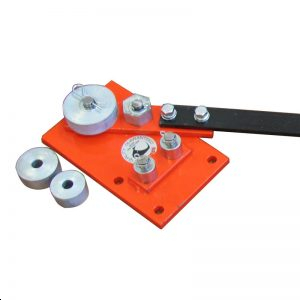
Manual Rebar Combination Machines
Manual rebar combination machines are available, which can be used to cut and bend rebar (up to 180 degree bends). The cutting and bending heads can be purchased separately to ensure you only get what you will need for your task. These units can also be mounted for easier operation.
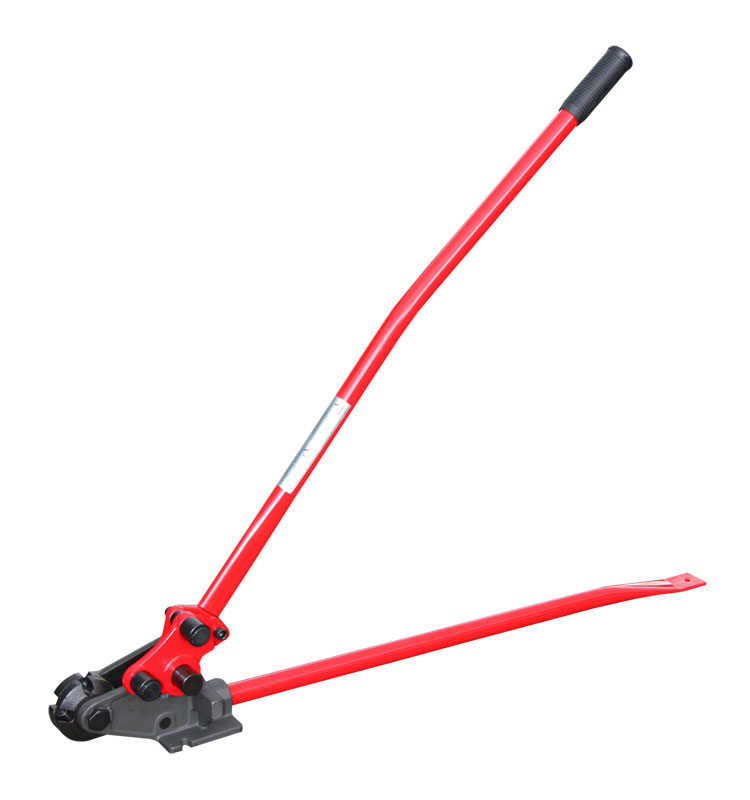
Hydraulic Rebar Machinery
Many manufacturers of rebar machinery produce smaller portable models suitable for contractors that require rebar cutting and rebar bending on the job site or who need to move their machine around the workshop for jobs such as the construction of precast panels and general formwork.
Hydraulic rebar machines are just another, more efficient way of cutting and bending rebar compared to their manual counterparts. These machines have a small footprint and lightweight design, which are easy to use. The best portable rebar benders/cutters are engineered with versatile functions that allow the user to adjust the machine to cater to different size rebars.
Pros
- Onsite flexibility.
- Portable/handheld.
- Less fatigue compared with manual cutters/benders.
- Can be used on a wider range of rebar diameters.
- Increased cutting/bending capacity and speed.
Cons
- Limited capacity and duty cycle.
- Not suitable for constant use or high-volume production.
- Prone to overheating.
It is important to buy a high-quality portable electric rebar cutting or rebar bending machine that is the correct capacity for the application. Here are a few units we pride ourselves in providing.
Diamond DBR32-HD Portable Electric Rebar Straightener/Bender
The Diamond DBR32-HD Portable Electric Rebar Bender/Straightener is a powerhouse, capable of bending/straightening rebars up to 32mm in diameter with a maximum tensile strength of 620 N/mm squared — more than enough to handle your rebar-bending needs.
The rebar machine can bend to a maximum of 90 degrees in 12 seconds. It weighs 28kg, which is a bit heavy, but this unit can be used on the ground or mounted on a workbench as required. For onsite use a counterbalance cable can be attached to the lifting eye bolt to help maneuver the machine into position.
However, if you need to bend rebar with a larger diameter, then an industrial stationary rebar bending machine will be required. Alternatively, you could order the larger rebars pre-bent from a dedicated rebar processor.
-
$4,930.00 Excl. GST $5,423.00 Incl. GST
Product ID: DBR32-HD
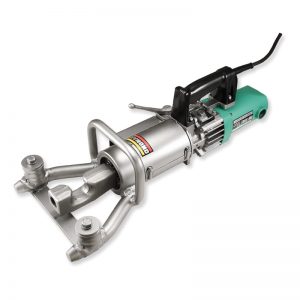
Diamond DC16W 16mm Rebar Cutter
If you know you will only be working with smaller diameter rebar, then this Diamond rebar cutter is the perfect choice. It is capable of cutting up to 16mm diameter rebar. The cutter can be powered from a standard wall outlet with 240V single-phase power, making this ideal for on-site work where a three-phase supply may not be available. The unit has a cutting speed of 2.5 seconds and is lightweight with a D-style handle for extra control.
-
$2,210.00 Excl. GST $2,431.00 Incl. GST
Product ID: Diamond-DC16W
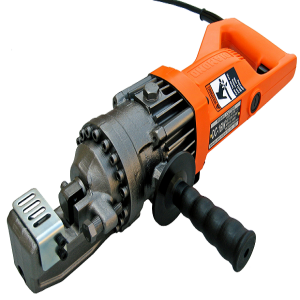
If you require a larger cutting capacity, alternative models are available, ranging in size (DC20W 20mm, DC20HL 20mm, DC25W 25mm, DC32WH 32mm). If supply power cables are a concern when working on-site, then battery operated units are the way to go. The Diamond DCC-1636HR 16mm Cordless Rebar Cutter cuts 4 to 16mm rebar (up to 560MPa) and does about 250 cuts of 16mm bar per charge. It comes with two batteries and a charger.
-
$4,930.00 Excl. GST $5,423.00 Incl. GST
Product ID: DBR32-HD
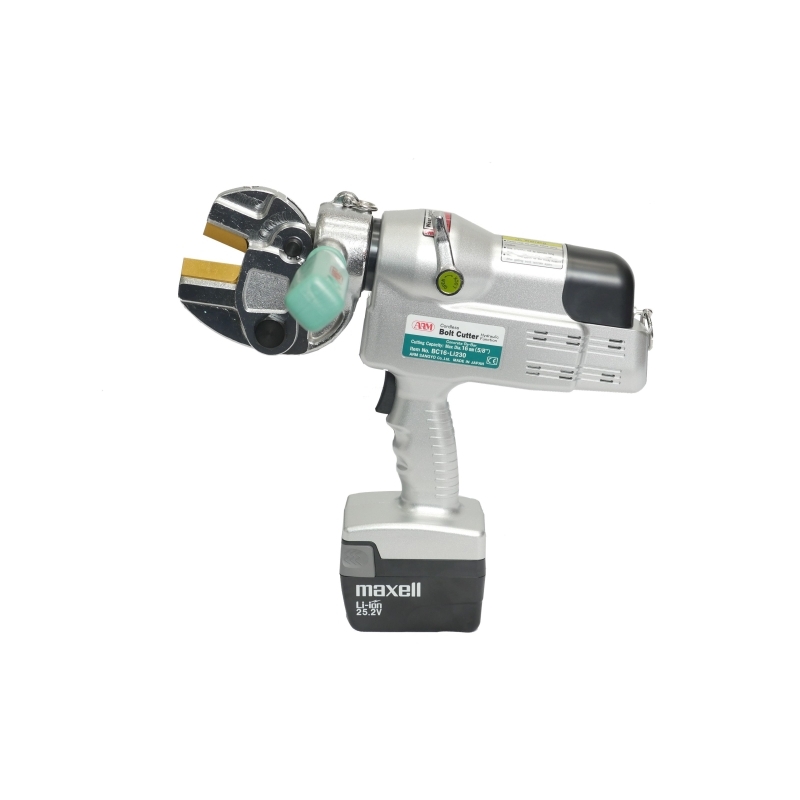
Arm Sangyo BC16-Li230 Battery Powered Cordless Bolt Cutter
Much like the Diamond DCC-1636HR rebar cutter, this Arm Sangyo model can be carried with you wherever you go regardless of a wall outlet. The blades are made of high-speed steel with a titanium coating for increased durability. It cuts 16mm rebar about 210 times per charge, and a full charge takes 120 minutes — make sure you purchase an extra battery for when your first one needs charging.
-
$5,798.00 Excl. GST $6,377.80 Incl. GST
Product ID: ARM-SANGYO-BC16-LI230
Pneumatic Rebar Machinery
When a compressed air source is readily available on-site, opting for a pneumatic rebar cutter is ideal considering that, over its lifetime use, it requires very little maintenance. Since air is being used to drive the cutting force, there is very little wear and tear on the internal components. Comparably, hydraulic rebar machines are prone to overheating and can leak over time.
Furthermore, some pneumatic rebar cutters have a long stem, thereby, extending the cutting reach and preventing the need to bend over, reducing fatigue and back strain. Lastly, although pneumatic cutters can be used for cutting rebar, generally, up to 16mm in diameter, they are best suited to precast yard and mesh processing facilities.
Pros
- Long reaching length.
- Minimal maintenance.
- Quick and simple to use.
- Fast cutting speed.
Cons
- Requires a compressed air source.
- Limited rebar cutting diameter.
Rapidcut-10L Pneumatic Cutter
The Rapidcut 10 series cutters are fitted with 1260TM cutter heads, which is capable of cutting 10mm diameter steel rebar up to 70kg/mm squared. The unit only weighs 8.5kg and can perform 40 cuts per minute. It requires a compressed air supply of between 6 to 8.5 bar. The air consumption is at 15 litres per cut at 7 bar.
-
$4,031.00 Excl. GST $4,434.10 Incl. GST
Product ID: RAP-03

Other Rapidcut models are available, namely, the Rapidcut 12, Rapidcut-12L, and Rapidcut 16. Compared with the Rapidcut-10L, the Rapidcut 16 weighs 18kg, can perform 10 cuts per minute, and consumes 48 litres of air per cut at 7 bar. Although these pneumatic rebar cutters are limited in power, they are more than ideal for 16mm diameter steel rebar and lower. Anything higher than 16mm diameter rebar will require hydraulic cutters.
Conclusion
Capital Machinery Sales is Australia’s largest ICARO supplier and distributor, with over 120 Italian-made ICARO rebar benders, rebar cutters and combined machines imported for reo workshops across Australia. Established over 20 years and backed by more than 30 years of experience in industrial machinery, manufacturing and service, we offer support well beyond a typical tool shop or reseller. We’ve supplied and serviced ICARO in Australia for 10 years.
From a 24mm bar bender to a 70mm heavy duty reo bender, plus rebar cutters, stirrup benders and spiral machines, we hold spare parts, bushes and pins in Melbourne, with on-site service, remote support and in-house repairs Australia-wide. When you call or need help, we’re there, and you’ll get instant, responsive support. Because of our extensive experience in machinery, we offer an exclusive extended 2-year warranty, so you’re covered well beyond the manufacturer’s standard 12-month warranty.
A few of our favourite portable rebar machinery have been mentioned, making your search for the best rebar machine much easier. These units ranged from our smaller, manual and pneumatic rebar cutters/benders to our larger hydraulic rebar cutters/benders (PortaForce, Diamond, Reflex and Rapidcut).
Our guide should equip you with the right information to make an informed decision on a portable/handheld rebar cutter/bender. However, when in doubt, speak to a rebar machine specialist to discuss your project and rebar needs in more detail. Capital Machinery Sales supplies, services and supports rebar machinery across Australia, for over 20 years.
Portable rebar machinery FAQ
What portable bar bender do I need for 32mm reo?
For 32mm reo on site, the PortaForce PF32B bends 25 to 32mm and the PF32SB bends and straightens 22 to 32mm, both on 240V. The Diamond DBR32-HD also bends and straightens up to 32mm. For 40mm, the PortaForce PF40WB. For 16mm and under, the Diamond HB16W.
Electric or hydraulic bar bender: what’s the difference?
Most portable “electric” benders are electro-hydraulic: a 240V motor drives a hydraulic ram. The PortaForce PF32WB and PF40WB split the hydraulic pump from the bending head, so the head is lighter to carry. The Reflex CBX bench benders are electric machines that bend 0 to 180°.
Should I buy a combined reo cutter and bender or separate machines?
A combined portable machine, such as the Diamond DBC16H (16mm) or DBC25X (25mm), does both jobs in one unit. Separate machines go bigger, such as the PortaForce PF32C cutter and PF32B bender at 32mm, and let you cut and bend at the same time.
Are cordless rebar cutters strong enough for site work?
For bar up to 16mm, yes. The Diamond DCC-1636HR cuts 4 to 16mm rebar and does about 250 cuts of 16mm bar per charge, with two batteries supplied. The Arm Sangyo BC16-Li230 cuts up to 16mm, about 210 cuts of 16mm per charge. Above 16mm, use a 240V cutter such as the PortaForce PF25C or PF32C.
Is a manual bar bender enough?
For occasional bends, yes. The Reflex Bramley manual bender bends up to 16mm mild steel, with less capacity on deformed reo. For daily reo work, a powered bender like the Diamond HB16W bends 16mm to 135° in about 8 seconds.
Can the same machine straighten bent reo?
Yes. The PortaForce PF32SB, PF32WB and PF40WB and the Diamond DBR32-HD all bend and straighten. The PortaForce PF32B takes optional straightening tooling.
What power do portable reo benders and cutters need?
The PortaForce PF22B, PF25B and PF25C run on 240V with a 10 amp plug. The PF32B, PF32SB and PF32C need a 15 amp plug. The Reflex CBX-32 runs on 240V single phase. Cordless cutters need no lead at all.
Can I cut reo flush to the concrete?
Yes. The BNCE-20 flush cut saw cuts 10 to 20mm rebar flush to concrete, on 230V.
Pneumatic or hydraulic rebar cutter?
Rapidcut pneumatic cutters run on 90 to 120 PSI air and cut up to 8mm, 10mm or 16mm, at 60, 40 or 10 cuts per minute. They suit precast yards and mesh work where air is on hand. Above 16mm, use a hydraulic cutter.
What’s a good rebar tying tool for site work?
The Reflex RTM45 cordless tier ties in under a second and does up to 4,800 ties per charge on its 18.5V battery. Two batteries are supplied.
How much does a portable reo bender cost?
Current prices for every portable bender and cutter are on each product page in our portable rebar machinery range. Finance is available.
What warranty do portable rebar machines have?
Each product page shows its warranty: 2 years on PortaForce benders and cutters and Reflex CBX benders, and 1 year on the Reflex RTM45 tier. We carry spare parts and blades and support what we sell Australia-wide.
Do you have stock, and how fast can I get it to site?
Each product page shows whether it’s in stock, and in-stock machines can often ship the same day. We deliver Australia-wide with tracking.
Portable or workshop machine: which suits my job?
Portable machines suit site work and bar up to 40mm. For daily production, several bars at once or bar up to 70mm, see our Industrial Rebar Machinery Buyer’s Guide.